Wiki-to-print
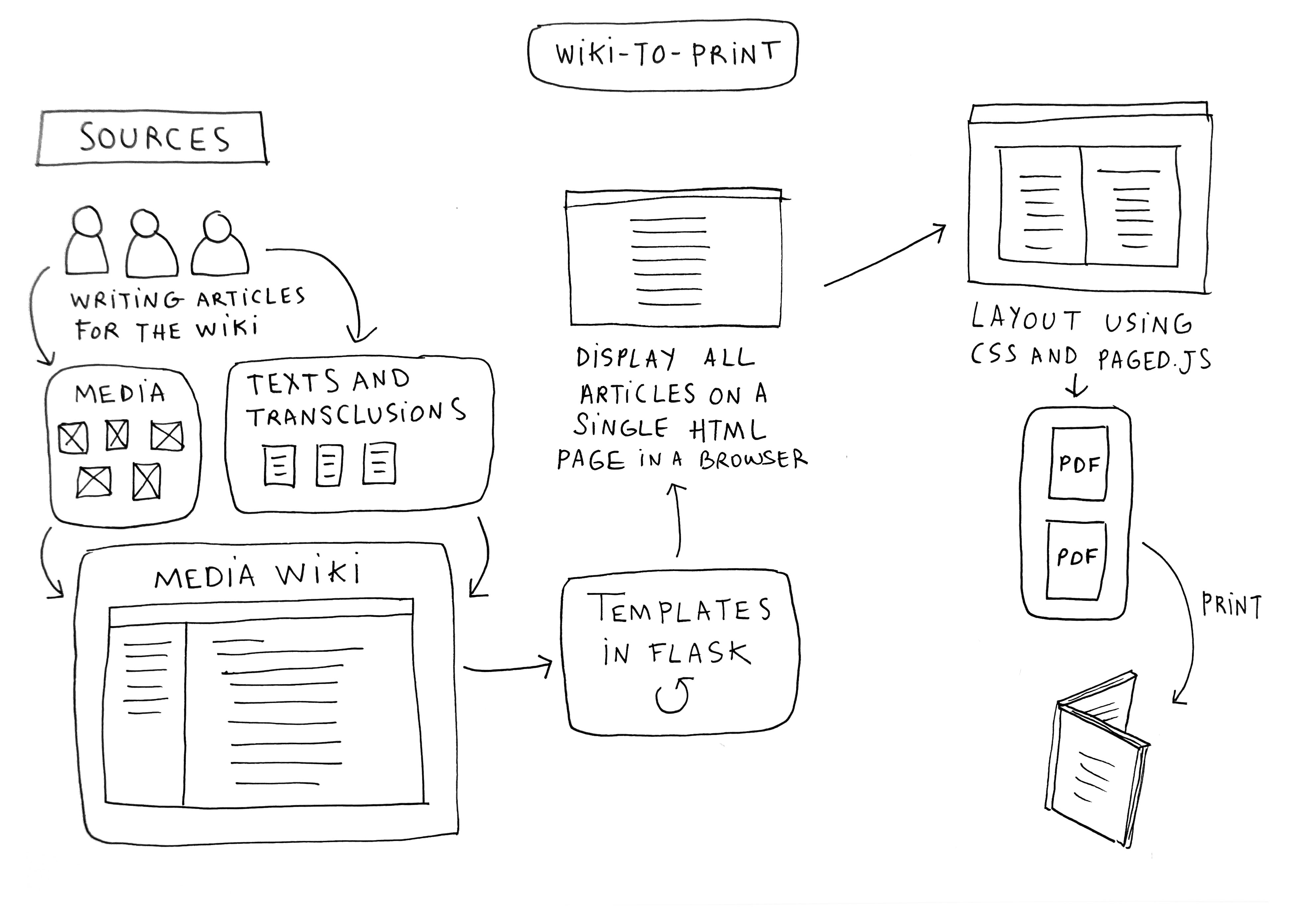
Wiki-to-Print is an editorial publishing workflow that turns collaborative MediaWiki content into designed and printable publications. Rather than treating the wiki as a drafting environment that is later exported into desktop publishing software, Wiki-to-Print considers the wiki itself as the primary editorial space, where writing, editing, annotating, and publishing remain closely connected.
The workflow enables publications to be written collectively in MediaWiki, assembled through transclusion, styled with CSS, and rendered as paginated HTML and print-ready PDFs using Paged.js. By relying on open standards and free software, it supports publishing practices in which writing, editing and designing are part of the same continuous process.
Instead of separating content from layout through proprietary tools, Wiki-to-Print allows editorial and design decisions to evolve together. The publication remains connected to its source material throughout its development: changes in the wiki can be synchronized with the publication, making it possible to iterate collectively while maintaining a reproducible publishing workflow.
The project follows a long lineage of experimental web-to-print practices developed within communities working around free software, collective publishing and critical infrastructures.
Over the years, this approach has been developed, adapted and extended through a number of publishing projects.
The earliest foundations were laid with Wiki-to-PDF, developed by TiTiPi and Martino Morandi for the publication Infrastructural Interactions. This project explored how MediaWiki could become the source of printable publications while preserving collaborative writing and open editorial processes.
These ideas were further developed through projects such as DiVersions, produced by Constant and Open Source Publishing (OSP), which expanded the relationship between collaborative online writing, CSS-based book design and web-to-print publishing. Related experiments, including Mondotheque, continued to investigate how wiki-based editorial environments could support complex publications.
The workflow was subsequently adapted for Volumetric Regimes, where the publishing pipeline was refined to generate high-quality printed books directly from MediaWiki content while introducing additional tools for image processing, typographic refinement and print production.
Hackers & Designers later developed a more integrated Wiki-to-Print environment that combined MediaWiki with a dedicated preview interface, allowing editors and designers to collaboratively inspect HTML and PDF renderings, edit publication-specific CSS, and continuously synchronize content and media between the wiki and the publication. They used this system to produce the book Making Matters.
Rather than a single software application, Wiki-to-Print is best understood as an evolving publishing practice: a shared editorial infrastructure that continues to be modified, reused and extended across different communities and publication projects.
Toolchain
MediaWiki → HTML → Templates → CSS → Paged.js → PDF
Sitography