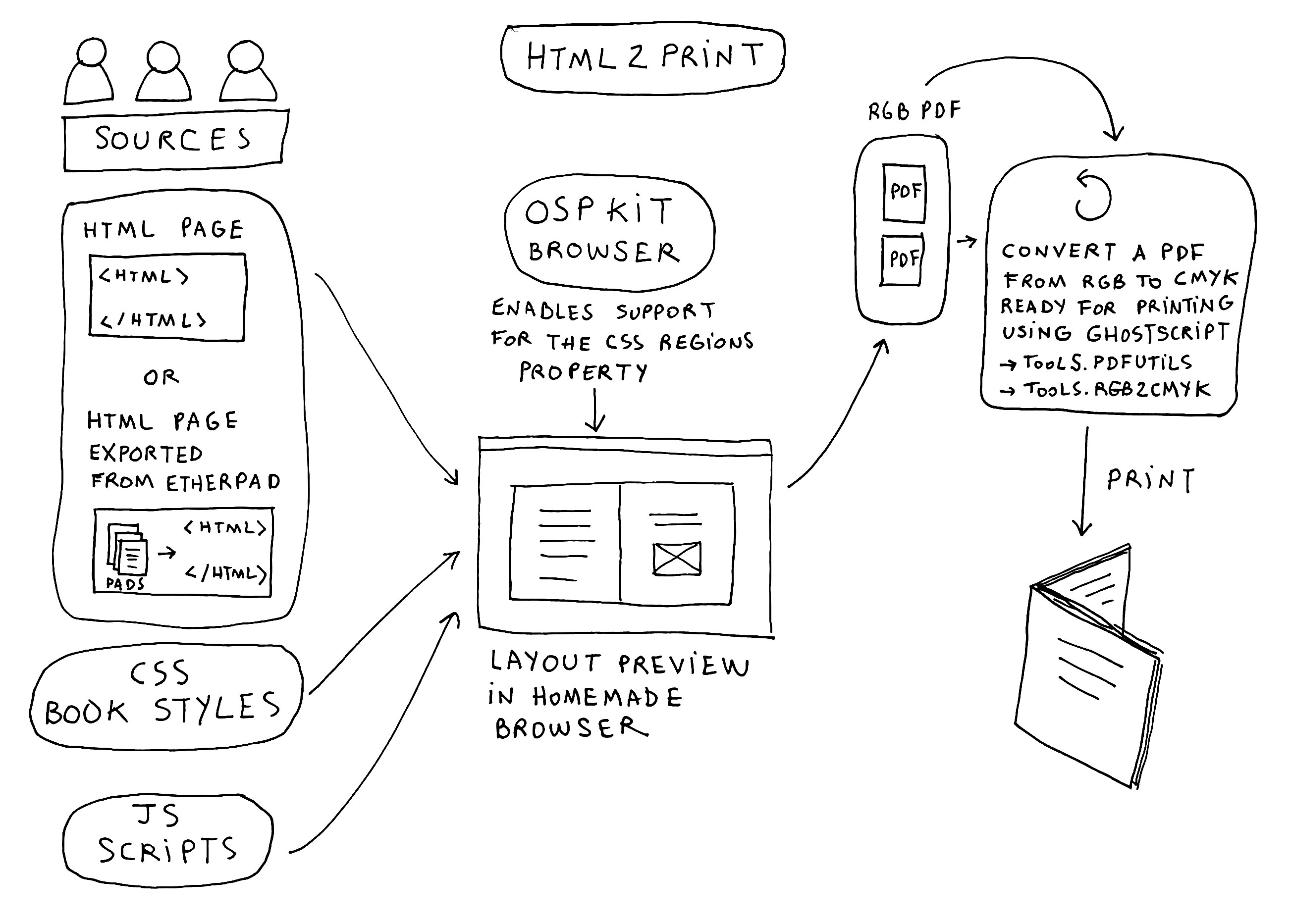
html2print
html2print is a web-to-print publishing workflow developed by Open Source Publishing (OSP). More than a software application, it is a boilerplate: a reusable starting point for designing printed publications with HTML, CSS and JavaScript. It proposes an alternative approach to graphic design in which the web browser becomes both a design environment and a production tool for print.
Rather than relying on conventional desktop publishing software, html2print embraces web technologies as native publishing tools. Books, posters, magazines and other printed matter are conceived as HTML documents whose layout is defined through CSS and whose behaviour can be extended with JavaScript. This approach makes it possible to move fluidly between writing code and visually inspecting the result using the browser’s developer tools, creating a continuous dialogue between programming and graphic design.
Because publications are described as text and code, html2print also supports collaborative modes of production. Content, layout and typographic rules can be edited simultaneously using shared editing environments, version control systems such as Git, or collaborative writing platforms like Etherpad. In this workflow, writing, editing, design and production become part of the same shared editorial process rather than separate stages of publication.
The project emerged from OSP’s long-standing engagement with free and open source software as both a practical and critical approach to graphic design. Since the mid-2000s, the collective has explored how publishing tools shape editorial practices, and how designing with open technologies can reveal and transform the cultural, technical and political infrastructures behind digital publishing. html2print is one expression of this broader research into web-based publishing and free software cultures.
A central concept in html2print is that of the boilerplate. Rather than providing a fixed application, the project offers a minimal, adaptable structure that can be copied, modified and extended for each publication. Every project becomes a new iteration: features are added, removed, rewritten or extracted into separate components according to specific editorial and graphic needs. Instead of converging toward a single stable tool, html2print has evolved as a growing family of related repositories, templates and experiments.
This understanding of software as an evolving collection of reusable recipes reflects OSP’s broader publishing practice. Boilerplates are not only technical templates but also archives of design decisions, collaborations and previous publications. They carry traces of earlier projects while remaining open to transformation, allowing techniques to circulate between publications without enforcing standardization. In this sense, html2print is inseparable from the communities and publishing practices through which it has developed.
Over more than a decade, html2print has been adapted for a wide variety of editorial and design projects, including books, magazines, posters, exhibition catalogues, collaborative publications and educational workshops. Its different iterations have incorporated evolving web standards, experimental CSS features, JavaScript tools, print production workflows and later developments such as Paged.js, while preserving its original emphasis on openness, experimentation and collaborative publishing.
Rather than a finished product, html2print is best understood as an evolving publishing practice: a shared infrastructure of code, design methods and editorial workflows that continues to be adapted, forked and reinvented through successive publishing projects and communities.